
Blog
Resume vs CV: What’s the Difference? A Complete Guide for Job Seekers

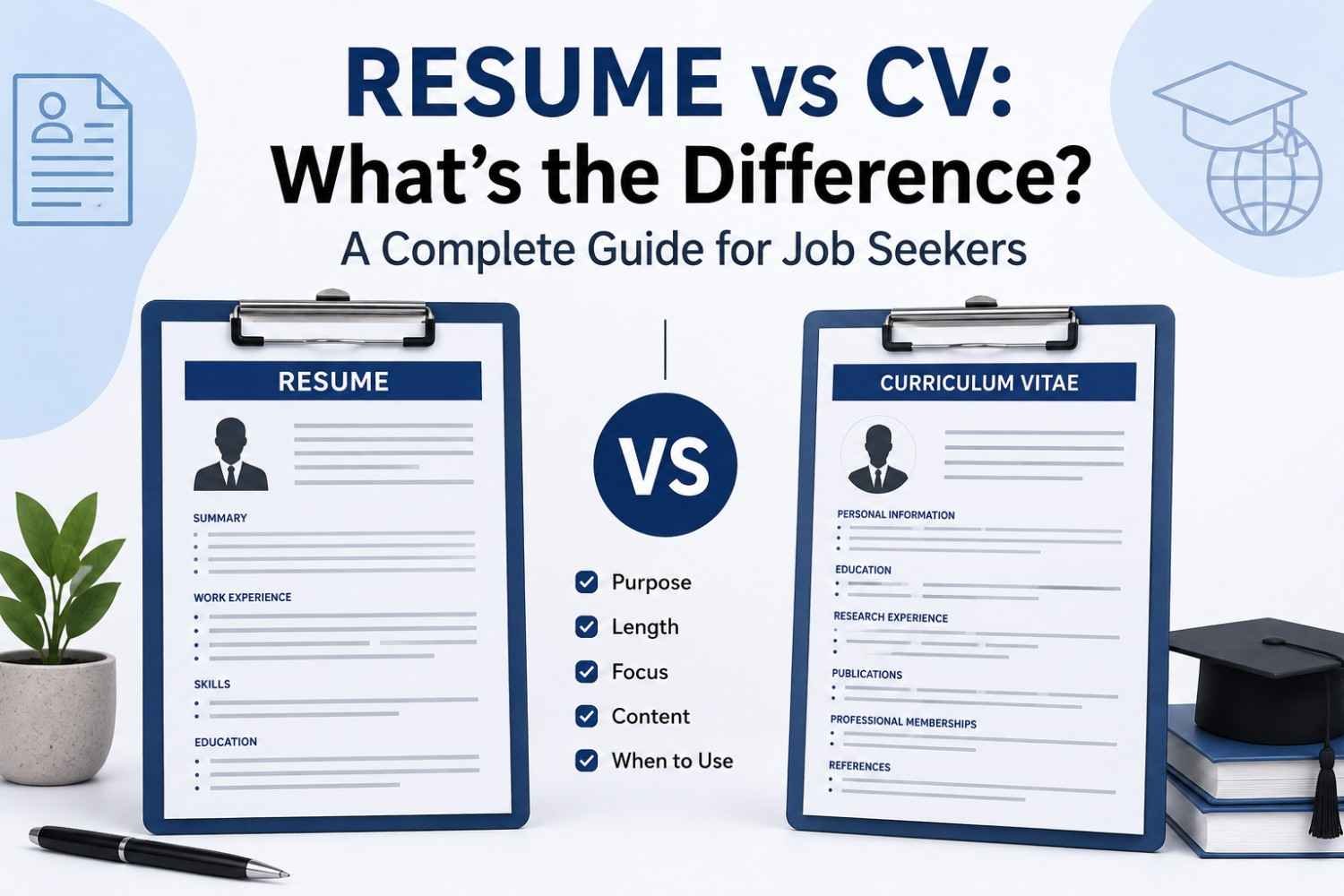
Whether you are applying for your first job, planning a career change, or preparing for higher education, understanding the Resume vs CV difference is essential. Many job seekers use these two terms interchangeably, but they are not the same. While both documents highlight your qualifications, skills, and experience, they differ in purpose, length, format, and the situations in which they are used.
In this guide, we’ll explain the Difference between Resume and CV, compare their formats, discuss when each should be used, and share practical tips to help you create a professional document that increases your chances of getting shortlisted.
What Is a Resume?
A resume is a concise document that summarizes your professional experience, education, skills, certifications, and achievements. It is typically one to two pages long and is customized for every job application.
Recruiters usually spend, like, a few seconds reviewing a resume before deciding if they should push a candidate to the next stage, so yeah, a resume that is well arranged should show fast why you fit the role. In general, most private firms and corporate organizations prefer this kind of document, because it delivers relevant details in a lucid, ordered way.
What Is a Curriculum Vitae (CV)?
A Curriculum Vitae, often called a CV, is a detailed document that presents your full academic and professional timeline. Unlike a resume, a CV is not limited to just one or two pages. It can contain educational credentials, research work, write-ups and publications, certifications, conferences, teaching practice, awards, projects, as well as professional memberships.
The Resume and Curriculum Vitae comparison really mainly boils down to how much detail, like how deep you go. CVs are often asked for when you’re applying to academic jobs, research-focused roles, fellowships, higher education programs, and also some government or international opportunities, yeah.
Difference Between Resume and CV
Understanding the Difference between Resume and CV helps you submit the right document for the right opportunity.
| Resume | CV |
| Usually 1–2 pages | Can be several pages long |
| Tailored for specific jobs | Includes complete career history |
| Focuses on relevant skills and experience | Covers academic and professional achievements |
| Preferred in corporate jobs | Preferred in academia and research |
| Updated for every application | Updated whenever new achievements are added |
Knowing these distinctions ensures that employers receive information in the format they expect.
Resume Format vs CV Format
The Resume Format vs CV Format also differs significantly.
A resume generally includes:
- Contact information
- Professional summary
- Work experience
- Education
- Skills
- Certifications
- Relevant achievements
A CV usually contains:
- Personal information
- Career objective
- Educational qualifications
- Research experience
- Publications
- Projects
- Presentations
- Awards and honors
- Professional memberships
- References
While both documents should maintain a professional appearance, resumes focus on relevance, whereas CVs emphasize completeness.
When to Use a Resume or CV
Many candidates are unsure when to use a Resume or CV. The answer depends on the position you are applying for.
Use a resume when applying for:
- Private companies
- Corporate jobs
- Startups
- IT and software roles
- Sales and marketing positions
- Customer service jobs
Use a CV when applying for:
- Universities
- Research institutions
- Teaching positions
- Scholarships
- PhD programs
- Academic fellowships
- Certain international job opportunities
Always read the employer’s application instructions carefully. If they specifically request a CV, avoid submitting a resume, and vice versa.
CV vs Resume for Freshers
The question of CV vs Resume for Freshers is common among recent graduates. In most cases, freshers applying for corporate jobs should create a resume rather than a detailed CV.
A fresher’s resume should highlight:
- Educational qualifications
- Academic projects
- Technical and soft skills
- Internships
- Certifications
- Volunteer work
- Extracurricular achievements
A CV becomes more appropriate if you are pursuing research, higher education, or academic careers where detailed educational achievements matter.
Resume and CV Writing Tips
Following effective Resume and CV Writing Tips can significantly improve your chances of getting shortlisted.
- Tailor your document according to the job description.
- Use clear headings and professional formatting.
- Include measurable achievements whenever possible.
- Keep information accurate and up to date.
- Avoid spelling and grammatical mistakes.
- Use industry-specific keywords naturally.
- Keep your contact details current.
- Save your document in PDF format unless another format is requested.
A professionally written resume or CV creates a positive first impression and demonstrates attention to detail.
Common Mistakes to Avoid
Many qualified candidates lose interview opportunities because of avoidable mistakes.
Some common errors include:
- Using the same resume for every application
- Adding unnecessary personal information
- Including outdated experience
- Writing lengthy paragraphs
- Using inconsistent formatting
- Ignoring ATS-friendly formatting
- Submitting documents without proofreading
Taking time to review your document before applying can greatly improve your chances of success.
Improve Your Interview Success Beyond Your Resume
A strong resume or CV helps you get shortlisted, but honestly, the way you perform in the interview is what decides if you’ll receive the job offer. So besides polishing those professional application papers, candidates should also really pay attention to communication abilities, self-assurance, body language, and the whole set of interview techniques.
Professional Interview preparation training in Rajouri Garden can help you get the idea of what employers expect, sharpen your answers for the usual interview questions, and feel more confident from hands-on practice. When you join Mock Interview Preparation as well, it usually makes it easier to respond without hesitation, take constructive feedback in a calm way, and ultimately do better when the real interview happens.
Final Thoughts
Understanding “Resume vs CV” is kind of more than just seeing the difference in length or how it is formatted. It is also about choosing the right paper for the right opportunity, and then showing your credentials in a way that feels clear and credible. If you’re going for your first job, or you’re switching careers, or you’re aiming at academic goals, picking the suitable document helps raise your odds of getting a good, positive reaction from recruiters.
Invest a bit more time into crafting a professional resume or CV, keep it refreshed regularly, and also align it with serious interview preparation. If the application is done properly and you show up with confidence, your odds of landing the job you want can jump, and your career progress can speed up too. At ExploreU, we help job seekers fine-tune their resumes and sharpen their communication abilities, plus we build interview confidence via expert guidance and hands-on practice, so you can actually perform well in today’s competitive job market.